Posts Tagged ‘rainy day projects’
How To Make Cool Sound Effects Instruments – Part 3
This is a series teaching how to make many of the cool sound effects instruments I use in my DrumSongStory programs. I will be updating these posts with video as well. I welcome your photos and videos, links and suggestions. These very simple instruments can also be made as part of a team building process for organizational and corporate groups who are interested in innovative ways to break the ice and build connections and community while having fun.
I’ve also held instrument making workshops just before a performance of Drum Of The Elephant King so that the participants can be an integral part of the show.
Here’s a small audio sample so you can hear how I use these instruments in my DrumSongStory programs:
Part One: How To Make A Rain Stick (Kid Quality)
Ages: 7 and older.
Time Needed: Approximately one hour for basic work. More time to decorate.
Materials:
- Cardboard Tubes.
a. Simplest – paper towel rolls.
b. Best sounding – 24″ Postal Tubes with a diameter of 2″-2 1/2″. (they usually come with end caps and can be ordered 50 at a time). - Nails one quarter inch shorter than the diameter of your tube.
- Hammer.
- Tape – Masking, duct, clear packing, or contact paper.
How To Make It:
- Draw a spiral along the length of your tube.
- Hammer nails along the spiral approximately one finger width apart.
- Fill with popcorn, rice, beans etc.
- Cap ends
- Cover nail heads with tape or contact paper.
- Decorate. One innovative teacher uses brown shoe polish over strips of torn (rather than cut with a scissor) masking tape. The result looks kind of like wood)
For Really Young Children (ages 4-5) you may want to try the following two alternatives:
- Instead of hammering nails, you can wad up small pieces of newspaper and fill your tube with that. Then put in the pop corn. You may need to experiment with different size wads.
- One innovative teacher suggested using an egg carton. Put the pop corn or beans and rice in an empty egg carton and tape closed. Turn so the stuff falls from compartment to compartment.
Part Two: How To Make A Rain Stick (Professional Quality)
For Older Instrument Makers (Middle School to Adult). This is how I make my own professional quality rain sticks
Materials:
- ABS Pipe (black, lightweight w/excellent sound quality) or PVC Pipe (white easy to find but heavier than ABS - 3-6 feet in length, 2 inches to 2 and 3/4 inches in diameter
- Bamboo barbecue skewers
- Sandpaper
- Colored tissue paper
- Water Based Polyurethane
- Brush
- Rubber end caps
- Electric drill with bit
- Filling material – popcorn, rice, dried peas etc.
How To Make It:
- Take a piece of ABS or PVC pipe, (the lighter weight black grade ABS Pipe is the easiest to work with. It is also louder. I think you can get it at electrical supply stores.)
- Drill holes in a spiral approximately 1/4 inch apart. You might want to mark the holes a head of time. But a little bit of free form is alright too. The holes should be large enough to accept the bamboo pegs snugly but not so snugly that they are impossible to hammer in.
- Cut the bamboo barbecue skewers into peg lengths that are just shorter than the diameter of the Tube. In other words you want the peg to go across the open space of the tube but not jam into the opposite side.
- Hammer pegs into holes. If the fit is nice and snug there is no need for any glue.
- Sand it so that the ends of the skewers are flush with the outside surface of the pipe.
- Experiment with different amounts and kinds of filler material. I started favoring dried peas because they are nice and round. But pop corn is a bit louder.
- Cap the Ends. I find that the rubber caps available at plumbing supply stores work well but eventually loosen up. After having the end caps fall off at the worst moments, spreading popcorn and rice all over the place in themiddle of a performance
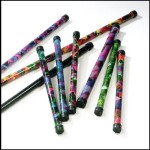
( I started gluing them. Elmer’s Glue only works for a while…So far the only thing that seems to hold is painter’s caulk or super glue (both of which can be messy and nasty). - Decorate – When I decorate my rainsticks I tear or cut tissue paper into small pieces and then paint them onto the tube with water based Polyurethane. The result is a very pleasing multicolored overlapping “Decoupage” effect. I then add several more coats of the Polyurethane (“glossy” is the shiniest but “semi-gloss” works too) for a deep shine sanding lightly between coast with a very fine grit sandpaper. When I have the black kind of pipe I just sand it and poly it. The ends of the skewers make a beautiful pattern on the black tube.
Time Needed: Depending upon the length of pipe you are working on, it could take anywhere from 4 to 10 hours of work to complete your rainstick. However, when it is done it will last a lifetime and give a lot of pleasure to anyone who plays it.
Tip: I have found that local plumbers and plumbing supply as well as electrical supply companies are quite generous in donating scraps of PVC pipe (some as long as 6 feet!) for making rainsticks. The rubber stoppers I use for the ends though are a couple of bucks apiece, but worth it for their protective value! Before you actually spend money on this project, give these folks a call and see what you can scrounge up. Good luck!
he How To Make Cool Sound Effects Instruments Series:
- How To Be A Shaker Maker
- How To Make A Cuica (a.k.a. Chicken In A Cup)
- How To Make a Rain Stick
- How To Make Wind Tubes
- How To Make An Ocean Drum
- How To Make A 2X4 Xylophone, Old Wrench Xylophone, Wind Chimes etc.
- How to Make A “Paint Stirrer Rhythm Stick”
- How To Make A “Paint Stirrer Stir Drum”
To book one of Mark Shepard’s DrumSongStory programs now, call 1-800-378-4971 or e-mail mark[at]markshepard.com
See what other DrumSongStory Programs are available for:
How To Make Cool Sound Effects Instruments – Part 2
This is a series teaching how to make many of the cool sound effects instruments I use in my DrumSongStory programs. I will be updating these posts with video as well. I welcome your photos and videos, links and suggestions. These very simple instruments can also be made as part of a team building process for organizational and corporate groups who are interested in innovative ways to break the ice and build connections and community while having fun.
I’ve also held instrument making workshops just before a performance of Drum Of The Elephant King so that the participants can be an integral part of the show.
Here’s a small audio sample so you can hear how I use these instruments in my DrumSongStory programs:
How to make a “Chicken In A Cup”
a.k.a. “Friction Drum”, a.k.a. “Guica” (Gwee-ka), a.k.a. “Cuica” (Kwee-kah)
Ages: 6 and up. Younger children may need help from grownups.
Time needed: 10-20 minutes including practice time.
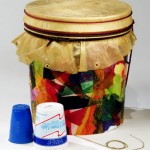
Check out the picture at left. The huge Guica is made out of a 5 gallon paint bucket. I took the bottom out, and stretched a piece of rawhide over it to see if it would make a decent drum. It was only so, so. But there are no failures in this business! I took a piece of waxed linen thread and turned it into a Guica. Now it sounds like an “Elephant In A Cup!” Next to it in the photo are the more usual sized materials.
Materials:
- Plastic cups (the sturdy kind) work the best but you can emphasize recycling by using plastic yogurt containers, or larger plastic sour cream containers. For a very temporary Guica you can use a paper cup. Most kids will rip the bottom out of one of those pretty quick. You can experiment with different sizes and materials.
- Waxed Dental Floss (good) or Waxed Dental Tape (better – but more expensive and smaller amounts available)
- Hammer & Nail: or other tool that will make a decent sized hole in the bottom of a plastic cup.
How To Make It:
- Punch two holes in your plastic container about a finger’s width apart. It helps if your nail is a decent size. It might also be possible to squeeze the cup and snip the holes out with a pair of good quality scissors. Or you could thread a large needle with the Floss and “sew” your floss into the bottom of the cup.
- Take a piece of waxed dental floss about as long as a child’s outstretched arms or one long adult arm and thread each end through a hole.
- Pull the ends through the inside of the cup and make sure they are even.
- Tie a simple knot as close to the holes as possible so the sting doesn’t fall out and so the knot is not in the way of your fingers sliding up and down the string.
- Shazaam! you now have a genuine “Chicken In A Cup”.
Some Tips: When I do large workshops I make the holes in all the cups ahead of time. Making the holes is not a kid activity. And is included here only for adults. I make a charcoal fire in my outdoor grill. I heat up a couple of nails. Using heavy work gloves and a pair of vice grips I grab a hot nail and melt the holes through about 5 cups at a time. Danger: The fumes from the melting plastic are toxic. They also smell nasty. I make sure there is a decent breeze blowing and I hold my breath when necessary. Wearing a protective mask is also a good idea.
I’ve also used an electric drill on a slow setting to drill down through as many as a dozen plastic cups at a time.
How To Play It:
- Hold the cup in one hand and lightly hold the strings in your other hand as close to the cup as possible.
- Then gently slide your hands along the string.
- You should hear an amazingly chicken-like sound. Particularly if you do it in short jerks.
- If you do it in one long smooth pull it sounds more like a sea-gull or maybe a wild animal.
- The larger the cup the bigger the sound.
Some Playing Tips: The sound is created with friction. So, if your hands are greasy or if the wax has been worn off your string by a lot of playing, it might not work as well. In that case wash your hands with soap and water and either get a fresh piece of waxed floss or use a piece of beeswax (available at hobby stores) to re-wax the string. Another technique is to use a small piece of wet sponge. Experiment!
The How To Make Cool Sound Effects Instruments Series:
- How To Be A Shaker Maker
- How To Make A Cuica (a.k.a. Chicken In A Cup)
- How To Make a Rain Stick
- How To Make Wind Tubes
- How To Make An Ocean Drum
- How To Make A 2X4 Xylophone, Old Wrench Xylophone, Wind Chimes etc.
- How to Make A “Paint Stirrer Rhythm Stick”
- How To Make A “Paint Stirrer Stir Drum”
To book one of Mark Shepard’s DrumSongStory programs now, call 1-800-378-4971 or e-mail mark[at]markshepard.com
See what other DrumSongStory Programs are available for:
How To Make Cool Sound FX Instruments – Part 1
This is a series teaching how to make many of the cool sound effects instruments I use in my DrumSongStory programs. I will be updating these posts with video as well. I welcome your photos and videos, links and suggestions. These very simple instruments can also be made as part of a team building process for organizational and corporate groups who are interested in innovative ways to break the ice and build connections and community while having fun.
I’ve also held instrument making workshops just before a performance of Drum Of The Elephant King so that the participants can be an integral part of the show.
Here’s a small audio sample so you can hear how I use these instruments in my DrumSongStory programs:
How to be a Shaker Maker
This is probably the easiest instrument for small children (and C-level executives) to make. Ages 3 and up.
Time Needed:
Approximately 5-10 minutes. (Longer for grown-ups
)
Materials:
Any closeable container. I prefer small plastic bottles, film canisters (now an endangered species since digital photography), even those plastic Easter eggs. But there is no “wrong” container. I have heard great sounding shakers made out of soda bottles, cool whip containers, laundry detergent bottles etc.
Any small hard substance. I prefer pop-corn, beans, rices etc. but you can also use sand, gravel, BB’s, clean kitty litter etc. Half the fun is experimenting.
How to Make It:
- Open up your container and put the pop-corn etc. inside.
- Close container
- Shake.
Does it sound good? Try putting less shaker material. Try putting more in.
Note to teachers and parents (and managers in some corporations): For some groups you may want to glue or tape the containers closed. Have a broom and dust pan on hand for clean up.
If time permits you can then decorate your shakers.
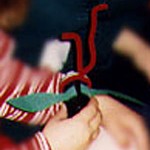
At one school, the kindergarten teachers (don’t you just love kindergarten teachers?) had their students decorate their film canister containers with little glue-on eyes, paper wings and pipe cleaners.
It was cool because they really looked like bugs! We were using them to create the sound of “Insects Buzzing In The Grass” in my Drum Of The Elephant King Program.
How To Play It: Just Shake It Baby!
Alternative shaker for when you just want to groove to the music and don’t have handy household materials around. Just shake your keys.
Next in the series:
How To Make A Cuica (a.k.a. Chicken In A Cup)
How To Make a Rain Stick: Part One & Part Two
How To Make Wind Tubes
How To Make An Ocean Drum
How To Make A 2X4 Xylophone, Old Wrench Xylophone, Wind Chimes etc.
How to Make A “Paint Stirrer Rhythm Stick”
How To Make A “Paint Stirrer Stir Drum”
